


Sitting off the southern tip of India, Sri Lanka can all too easily be overlooked by holidaymakers enticed by the broad appeal of its bigger neighbour. But this beautiful country has much to offer, especially for those with limited time who might be a little overawed by the sprawling expanse and chaotic ‘busyness’ of India.
I recently took a ten-day break in Sri Lanka as a guest of Bamboo Travel. During this time, I was part of a group of travel consultants and tour operators who were given a sample 10-day tour. This gave me the perfect overview of what one might expect to experience during a holiday of this duration and a look at the quality of some of the hotels where a high-end traveller could stay.
Day One – Flight To Colombo
The flight from London to Sri Lanka’s capital, Colombo took 11 hours. Many airlines cover this route, but I enjoyed a comfortable flight with Sri Lankan Airlines.
Colombo
With a population of over five and a half million people, Colombo, is a typically fast-paced, densely populated capital city. It’s quite similar to many of the larger Indian cities in that respect, but very different to the rest of Sri Lanka. My visit didn’t include a stay in Colombo, but it can easily be included in any itinerary and is certainly worth a couple of nights’ stay. If your time there is limited, a fun way to see the city would be to book an official tuk-tuk city tour. This way, you would be surrounded by the hustle and bustle of a vibrant and colourful city, whilst still being one step removed.
If you do choose to stay in Colombo for a couple of nights, don’t miss the Gangaramaya (Vihara) Buddhist Temple. There are more Buddha statues there than you will be able to count! They come in all shapes, sizes and colours and are made from all kinds of materials – some completely unexpected, even nuts and bolts! There are also plenty of other things to see there, such as stuffed animals, antique cars, and furniture. Top tips: Make sure you wear some socks, though, as you’ll have to leave your shoes outside, and some of the outdoor surfaces can become pretty hot underfoot in the searing heat of the day.
A visit to the National Museum of Colombo will provide some insight into the country’s social and cultural history. The museum houses Buddhist art, demon masks, and artefacts related to the Kandyan monarchs of the past.
The candy-striped mosque, Jami Ul Alfar, is also worth seeing. However, due to its central location beside a bustling market, it can get very busy.
Visit the observation deck at the Lotus Tower, one of the tallest structures in South Asia, for an unsurpassed panoramic view of the city.
Day Two – Kegalle
Kegalle is just under 85km inland from Colombo, about a two and a quarter hour drive. We stayed at Rosyth House – a family home converted to a boutique hotel, which provided the best of both worlds, providing a very family feel, but also with lovely staff tending to our every need. We arrived at night to heavy rain, which soon dried up to allow us our first sights of the fabulous views over the hills and open countryside. Included as part of our itinerary was a foot massage, drinks and dinner, and a cookery demonstration.
Day 3 – Kegalle- Sigiriya
The next morning I enjoyed an early-morning bird watching session followed by breakfast which included a hands-on hopper making session with the chef. This was great fun – first, the chef did a demonstration, then allowed us to have a go. Hoppers are a kind of filled savoury pancake – we had ours with eggs, but they can be filled with all sorts of things, such as curry or sambol (a relish, with ingredients like coconut, onions, chilli, lime juice, and spices).
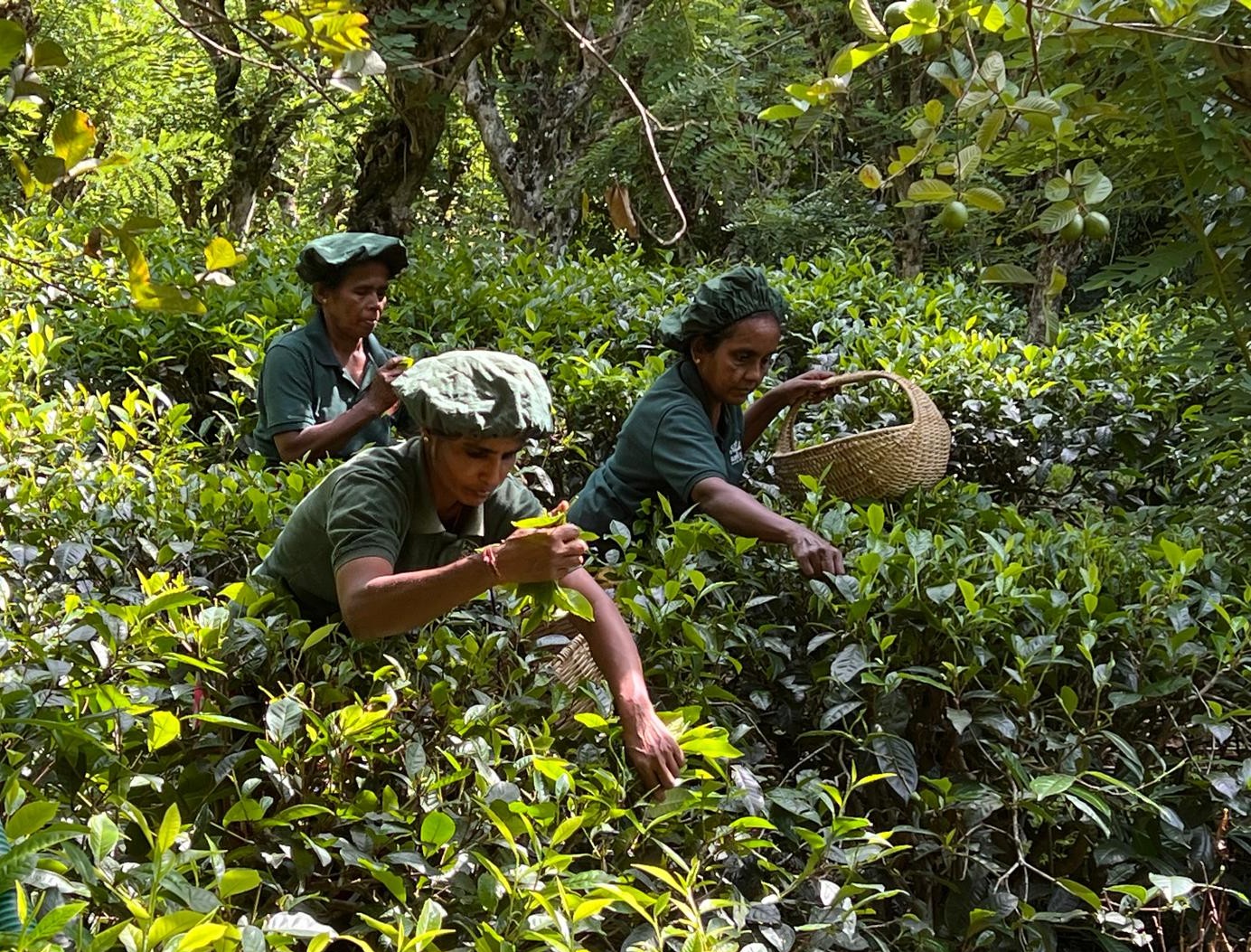
After breakfast, we were given a tour of the family’s tea plantation and small factory. It was interesting to see that everything is done by hand, from picking the leaves from the bush to the processing and packaging of the tea. This is quite a labour-intensive process. The tea-picking ladies allowed us to pick the leaves ourselves, rolling, pounding and sorting them. They laughed at our lack of skills!
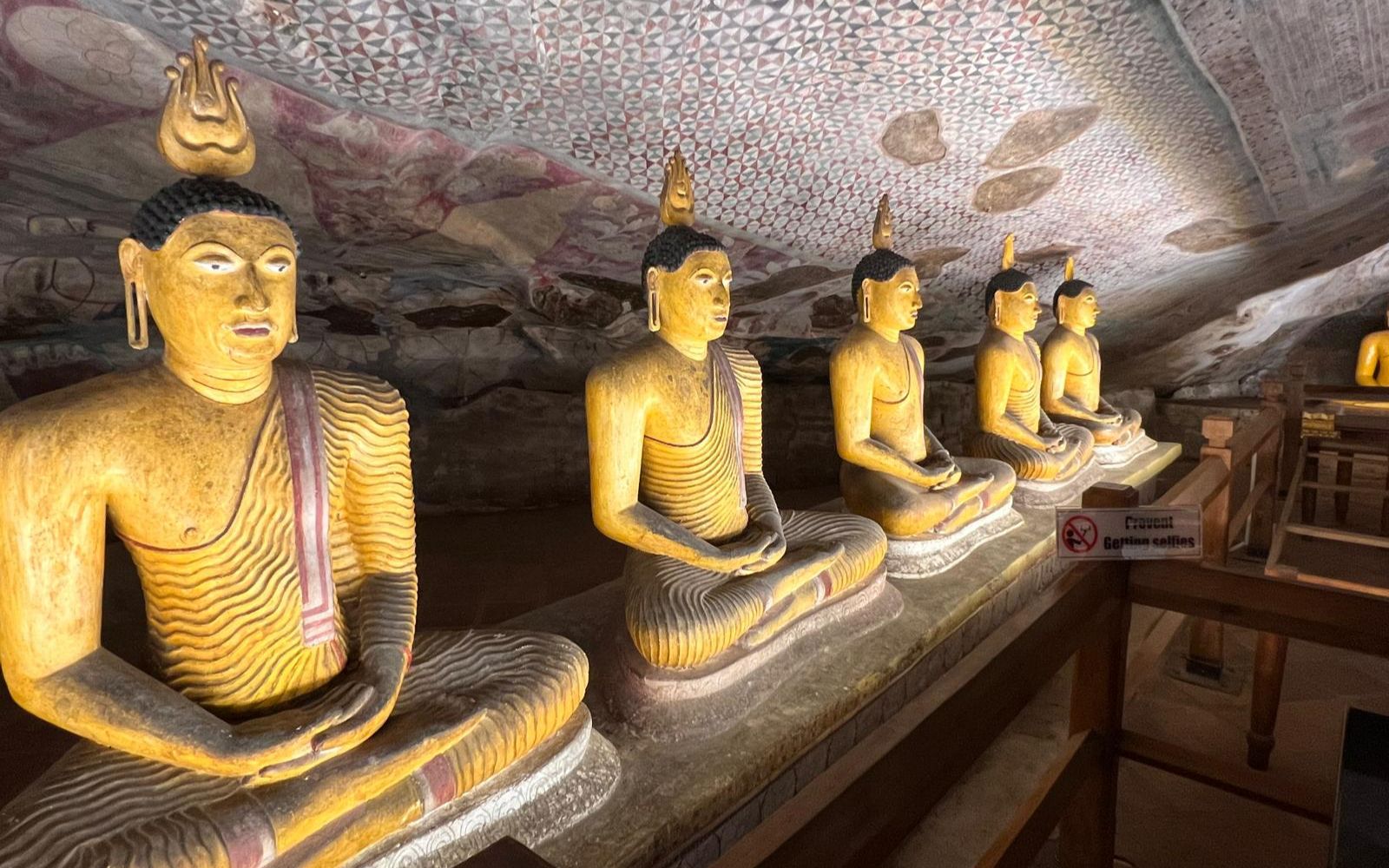
Our first trip of the day was to the Golden Rock Cave Temple complex at Dambulla. This involved a steep climb up steps carved into the hillside (the less physically fit could be driven halfway up). But the climb was worth it to see the five atmospherically lit caves, brimming with Buddhist statues and beautiful murals dating back more than 2,000 years. Because it’s a temple complex, we had to remove our shoes, but were allowed to keep our socks on, which I would advise. Knees and shoulders must also be covered, but shawls and sarongs are available to rent for a small price. Outside the caves, the elevated position gave us a great view of Sigiriya Rock.
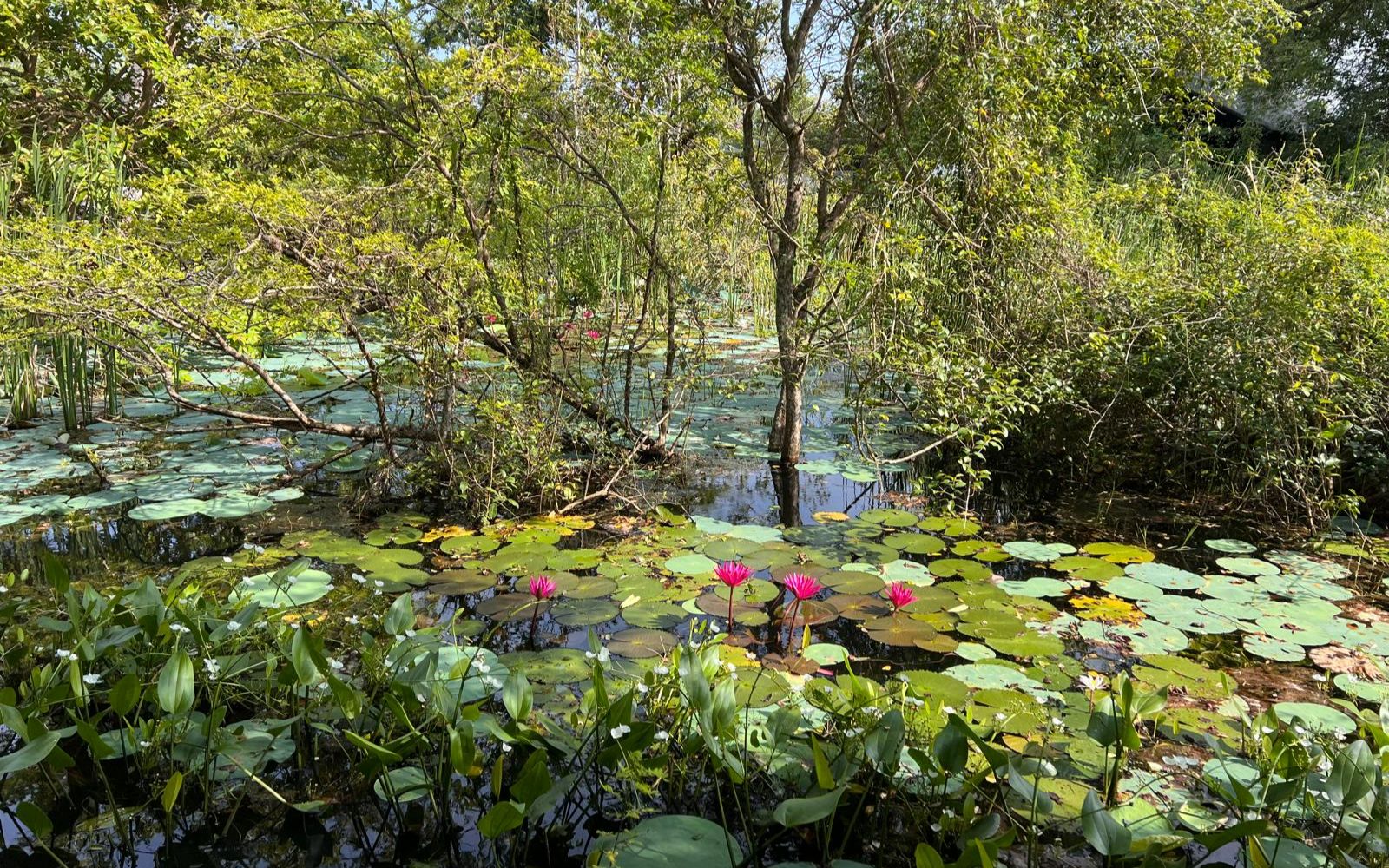
Our next stop was at the Sigiriya Kings Resort – a boutique-style hotel with fabulous views across the paddy fields to Sigiriya Rock and Lions Rock, where we enjoyed a delightful lunch. I found the private pool rooms to be particularly lovely. However, we weren’t staying here. Our hotel for the next two nights was to be the Water Garden Sigiriya. Our accommodation was large, villa-style and based around the water gardens. Here, we were truly pampered, with butler service for each villa. There were peacocks everywhere! And surprisingly, despite the presence of water, there were few mosquitoes. Apparently, this is because the fish in the water gardens eat the mosquito larvae.
Our stay included a Ceylon arrack tasting and pairing experience. Arrack is a local alcoholic drink made from the fermented sap of coconut flowers. It’s pretty strong and tastes a bit like a cross between brandy and whisky.
Day 4 – Sigiriya
We were up at 4 am to get to Sigiriya Rock. It’s best to climb early in the morning to avoid the crowds (parts of the climb have narrow steps, which aren’t so great for two-way traffic), and to ensure we made it to the top before sunrise.
Sigiriya Rock is, of course, more than just a rock! It is the site of a palace dating back to 5 AD and is one of the country’s most visited attractions. It still retains some of its original frescoes and plenty of evidence of the grandeur of ancient times. The views of the surrounding countryside from the top were amazing. There were plenty of cheeky monkeys and stray dogs, both of which are very used to people and are friendly, including some very cute puppies which I could have brought home! Although, personally, I wouldn’t touch either the dogs or the monkeys, as they are not vaccinated. Dogs with clipped ears have been vaccinated though. The Sri Lankan authorities are making a concerted effort to vaccinate more stray dogs, of which there are many.
From here, we went on to the Wild Grass Nature Resort, which offers well-spread-out villas and stilted accommodation lining the river and running through the jungle, several with their own pools, an interesting alternative to hotel accommodation.
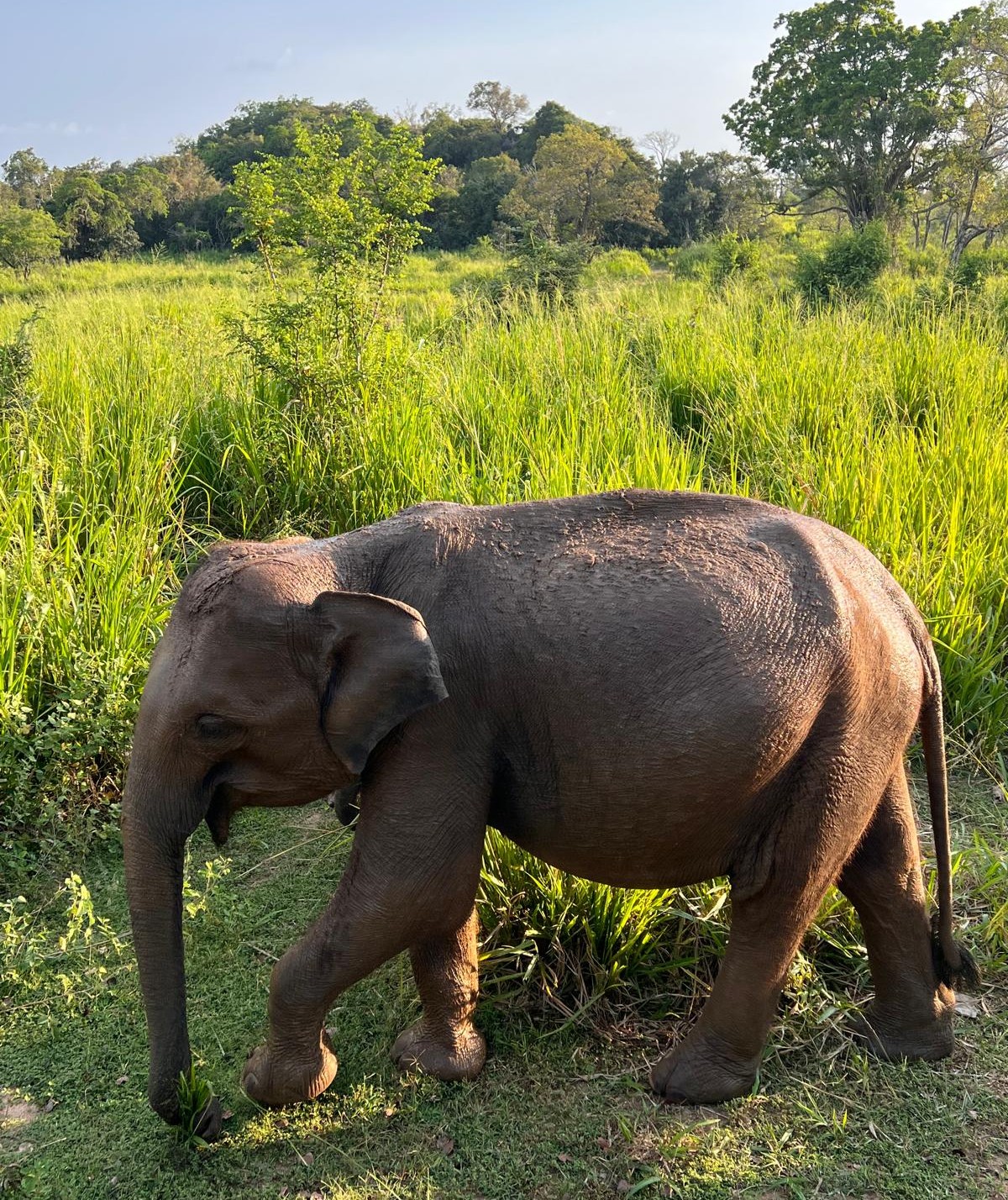
After lunch we took an afternoon safari at the Hurulu Eco-Park. Depending on ground conditions, the safari can sometimes also take place at the Minneriya National Park. This region of Sri Lanka is known locally as the ‘elephant corridor’, as so many elephants trek through here looking for fresh water. And we did indeed see plenty of elephants and bird life. Lots of baby elephants with their mothers – male elephants are not part of the herd. Asian elephants are much smaller than African elephants. We discovered that it’s possible to get very close to the herds from within your jeep. Watching the elephants graze the grasslands, giving themselves a mud bath to keep cool is mesmerising. Mothers protect the babies in the middle of the herd. How they use their trunks is also fascinating – one baby elephant wanted to play and blew the dust from the track road over a large black crow several times. He stamped his front feet and flapped his ears at the bird.
Day 5 – Sigiriya to Passikudah, via Polonnaruwa
In the morning, we travelled by road to the ruins of the ancient city of Polonnaruwa. Bamboo Travel offers a two-hour bicycle tour around the site, which we didn’t do, but which would nevertheless be a great way to explore the site, which features the remains of monasteries, shrines, palaces, pavilions, and parks. We also spent some time at the museum, where we learned about the area’s reconstruction following many years of civil war and the 2004 tsunami.
We had lunch at Maalu Maalu, a nice beach-side hotel on the east coast of Passikudah, a popular resort destination due to its long, golden sandy beach, where much of the reconstruction is taking place. Snorkelling and fishing expeditions are very popular, both here and in the nearby beach town of Kalkudah, with most of the resort hotels able to arrange these, as well as bicycle hire. Later, we continued to Uga Bay, which was to be our accommodation for the evening. We managed to fit in a swim before dinner. The sea was calm and lovely and warm, with no seaweed! I could have stayed in there for hours!
Day 6 – Passikudah to Ella
After breakfast, we toured Karpaha Sands Hotel, a fully air-conditioned luxury hotel with beautiful, tented accommodation, beach views, and garden views. The additional of luxury pool villa (tented) accommodation is coming in 2026.
We then visited the Kalkudah Beach House, a new hotel just about to open on a quiet stretch of Sri Lanka’s east coast, which is surrounded by coconut palms and overlooks the gorgeously turquoise ocean. With its own beach, and the Main House (three bedrooms) and Palm Villa (two bedrooms) sitting on opposite sides of a 22-metre swimming pool, the setting couldn’t have been more idyllic. A perfect escape for large family groups or groups of friends.
The drive to Ella, up in the hill country, took more than four hours, and although there was another deluge of rain as we arrived at 98 Acres Resort & Spa, our accommodation for the evening, the sky soon cleared, to reveal more spectacular views.
As a popular destination for adventure activities like canoeing and rock-climbing, Ella also has a vibrant bar and restaurant scene. To make the most of this, we enjoyed a ‘night out on the town’.
Day 7 – Ella
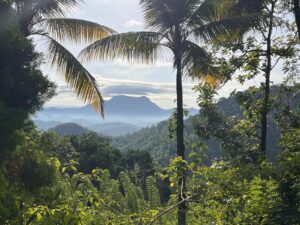
A really lovely town, Ella sits in the midst of beautiful rolling hills and tea plantations. Before breakfast, we scaled ‘Little Adam’s Peak’. This short climb was around 30 minutes, giving us an unparalleled view of the surrounding scenery. It was a relatively easy climb, but I was grateful that I’d remembered to wear my trainers!
There are some other great walks that can be done from Ella. The Ella Rock trail takes you through lush valleys and plantations and the Ravana & Bambarakanda Waterfalls are within easy striking distance (Bambarakanda, a day’s hike from Ella, is the highest waterfall in Sri Lanka).
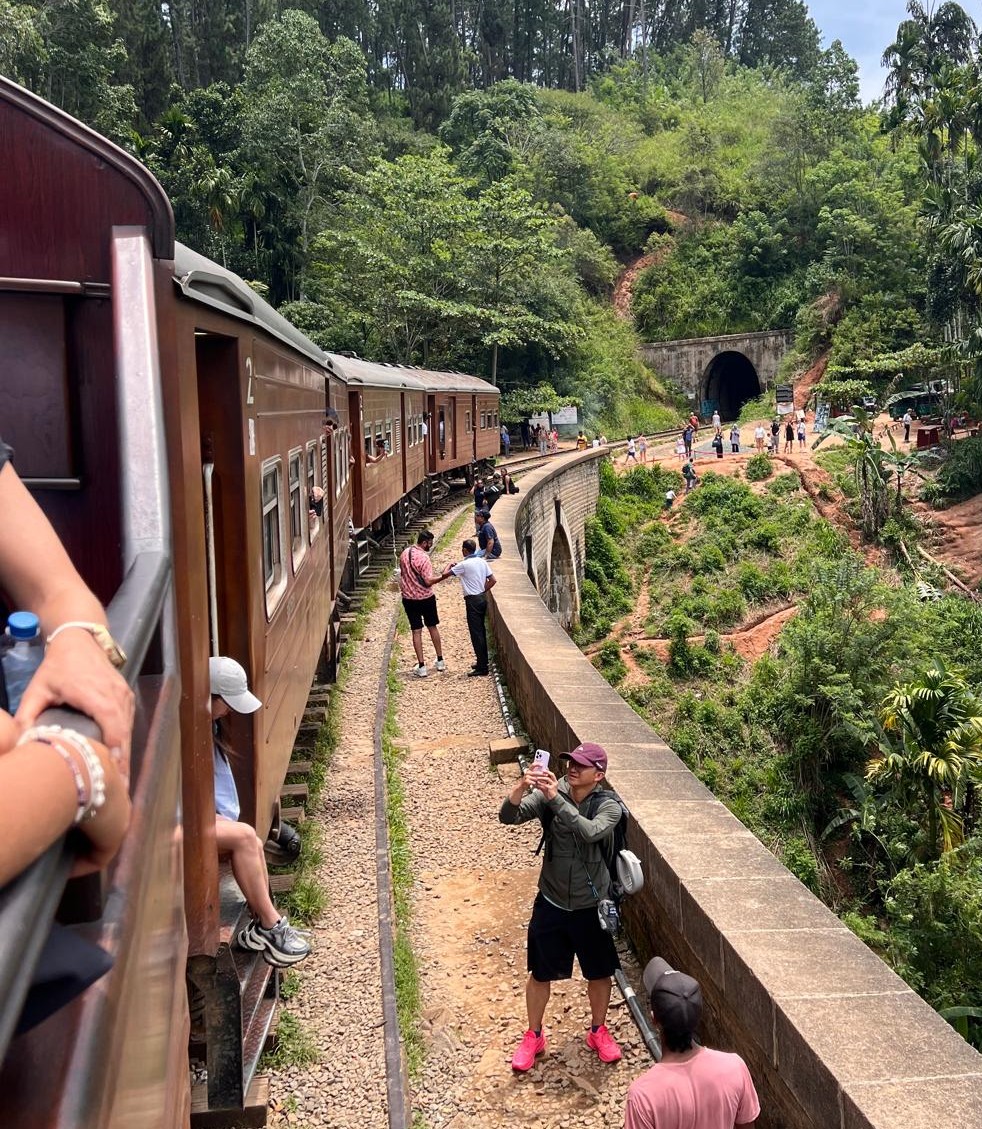
In the afternoon, we travelled by tuk-tuk to the Nine Arches Bridge, which was envisaged by the British, but mostly constructed by Sri Lankans out of stone and cement, when steel was in short supply during the First World War. Next, we were on board a train to Demodara. This wound through some lovely scenery, small villages where tea-pickers live and tea plantations. There are outdoor carriages on the train, perfect for photos and video, but these can get busy, so it’s always best to book a seat too. Although we were only on the train for 20 minutes, longer journeys are of course also possible.
Once in Demodara, we checked into Nine Skies, a small hotel (previously a family-owned bungalow) with only a handful of rooms. In the afternoon, we took a 6km hike through the tea plantations to do some bird-spotting. But beware of leeches in the long grass after rainfall. I got one on my ankle, which was easily removed by the guide. I didn’t need to worry about needing any shots, as leeches do not spread diseases. Leech socks are often provided, if requested.
After enjoying dinner at the hotel, the following morning, whilst sitting on the veranda drinking my morning cup of Ceylon tea, a family of mongoose crossed the grass in front of me. Don’t be fooled by their cute furry faces though, they are vicious and will even take on snakes.
Day 8 – Ella to Yala National Park
After arriving in Yala National Park, our afternoon safari was hosted by a company called Leopard Trails, which also provided accommodation for us in deluxe tents (mine even had a pool!). Yala is Sri Lanka’s most famous National Park and is known both for its accessibility and abundance of exciting wildlife, such as crocodiles, elephants, wild buffalo, sloth bears, monkeys, wild boar, and deer.
We spotted plenty of birds, deer, water buffalo, crocodiles, elephants and monkeys, but no leopards or sloth bears on this occasion. The leopards had earlier been sighted mating on an outcrop but were nowhere to be seen when we arrived at the same spot. The best time to spot animals is often first thing in the morning.
Drinks around the campfire as a group, then dinner.
Leopard Trails is a permanent camp. I had a tent with a pool! (Kumana Under Canvas offers a fully mobile semi-luxury campsite an hour’s drive from the entrance to Kumana.)
Day 9 – Yala to Galle
After breakfast, we headed west toward Galle and stopped for a hotel inspection at the Relais & Chateaux hotel Cape Weligama.
The hotel sits proudly on Sri Lanka’s southern cliffs and is undeniably an unrivalled coastal retreat. With its luxurious villas and suites, breathtaking ocean views, and world-class cuisine, it was exactly the kind of high-end luxury one would expect from R&C. It was the perfect setting for a relaxed lunch.
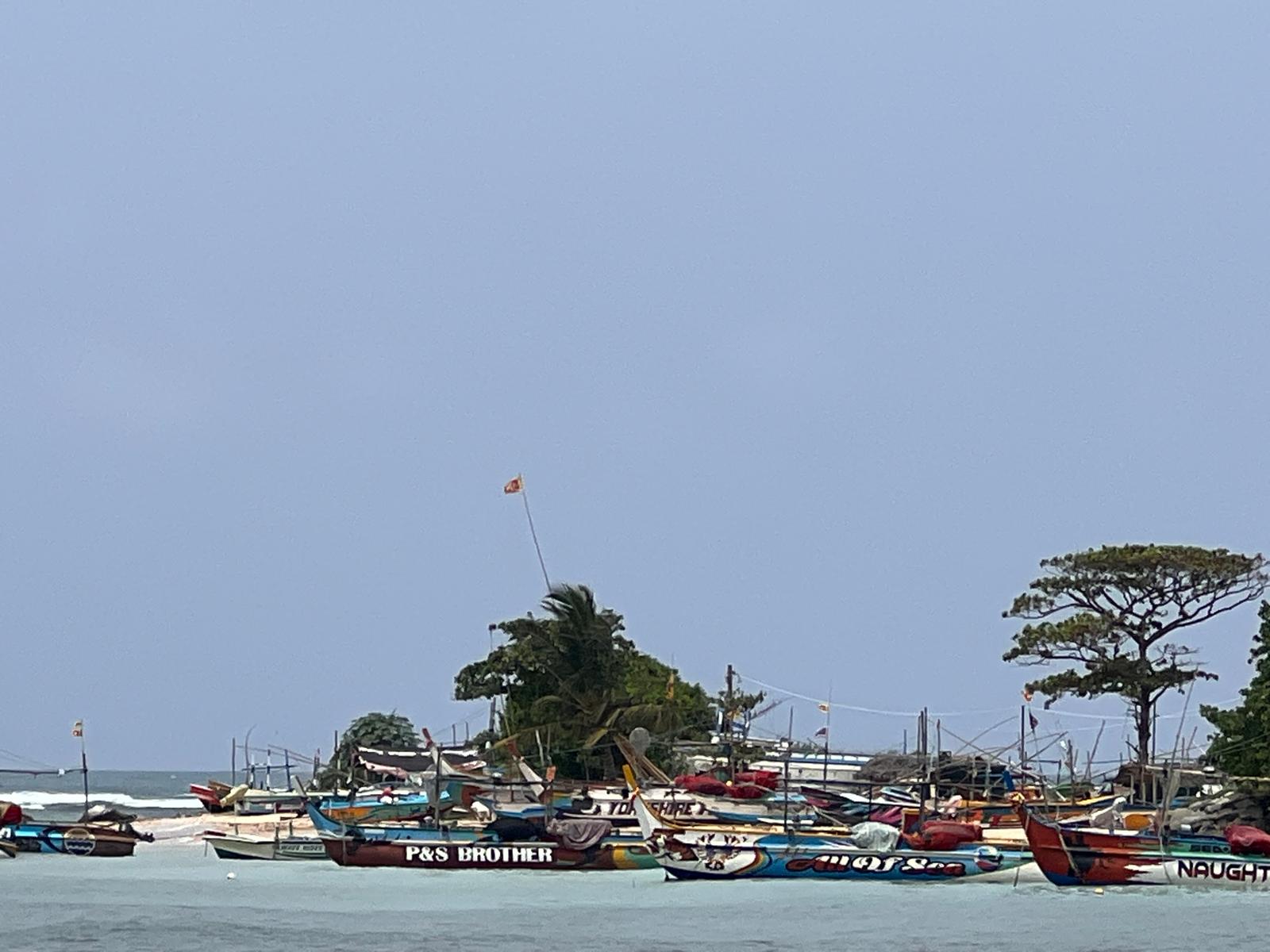
Galle is the jewel of Sri Lanka’s south coast. The city is built around the Dutch Fort, a UNESCO World Heritage Site dating back to the 13th century, which remains a vibrant community of shops, cafes and houses even to this day. The fort was constructed during the Dutch colonial era and has a very different atmosphere to the rest of what is a charming, modern city. Walking along the walls of the fort, you’ll see some great views of the lighthouse, the Indian Ocean, the city, and Galle Cricket Ground, which is widely reputed to be one of the most attractive test cricket venues in the world.
After arriving at Galle, we checked into our hotel, Fort Bazaar, and were given a tour around Galle UNESCO World Heritage Site by our guide.
Later, there was time to do some shopping for souvenirs in the town before returning to the hotel for dinner and packing for our flight home!
Day 10 – Galle to Colombo Airport and return flight to UK
The drive back to the airport took around two and a half hours, then we were flying home.
Points of Interest
Wildlife is constantly around you. Monkeys, birds, even the odd snake. The birds can be deafening in the morning, and I was often awakened by them.
I highly recommend not going it alone in Sri Lanka. Have a tour guide who can also be your driver; you will get so much more out of your time there.
Remember, when visiting Buddhist temples (and mosques), you must remove your shoes and cover your knees and shoulders.
Infrastructure
Most roads are single carriageway and tarmacked, but drivers can be impatient, there is always overtaking, and we often found ourselves three abreast across the road. This isn’t necessarily a problem unless you’re driving yourself, as it is what the locals are used to. In towns, tuk-tuks make the roads busy and chaotic, as do mopeds and small motorbikes, often seemingly with an entire family and a fridge balanced on the back! No, not really, but I have seen a family with a ladder and all sorts of other paraphernalia wobbling on the back of a motorbike.
There is a dual carriageway that runs around the southwest coast towards Colombo and the airports. This was the road we took back to the airport from Galle.
Flights
We flew with Sri Lankan Airways, but there are many others to choose from. Although we flew economy, there was plenty of legroom, even for such a long flight.
Money
Sri Lankan Rupee – you cannot buy this before you travel. But you can exchange money at the airport, which we found provides the best exchange rate, and use ATMs in towns.
When to Travel
The Sri Lankan climate varies from place to place throughout the year. But there is generally sunshine to be found somewhere for most of the year. December to March is the best time to visit the west coast, the south and the centre of the island, when the skies are blue and the temperatures and pleasantly warm. During the rest of the year, you may experience monsoon weather. However, the best time to visit in the north and the east coast is from April to September.
One last thing…
I was travelling with a nut allergy, which can be a scary thing in Asia, where nuts are widely used in many dishes. However, this was not a problem, as I found that everyone catered to this need brilliantly.
I found no significant problems with the language barrier, as English is widely spoken, even in the hillside villages.
If this has inspired you to visit Sri Lanka, I’d be delighted to help craft a bespoke Sri Lankan adventure for you.
Disclaimer
My recent trip to Sri Lanka was hosted by Bamboo Travel, Sri Lankan Airways, Ceylon Tours, Rosyth Estate House, Water Garden Sigiriya, Uga Bay Resort, 98 Acres Resort & Spa, Nine Skies, Leopard Trails and Fort Bazaar. This blog was not requested by them. All opinions are my own.

